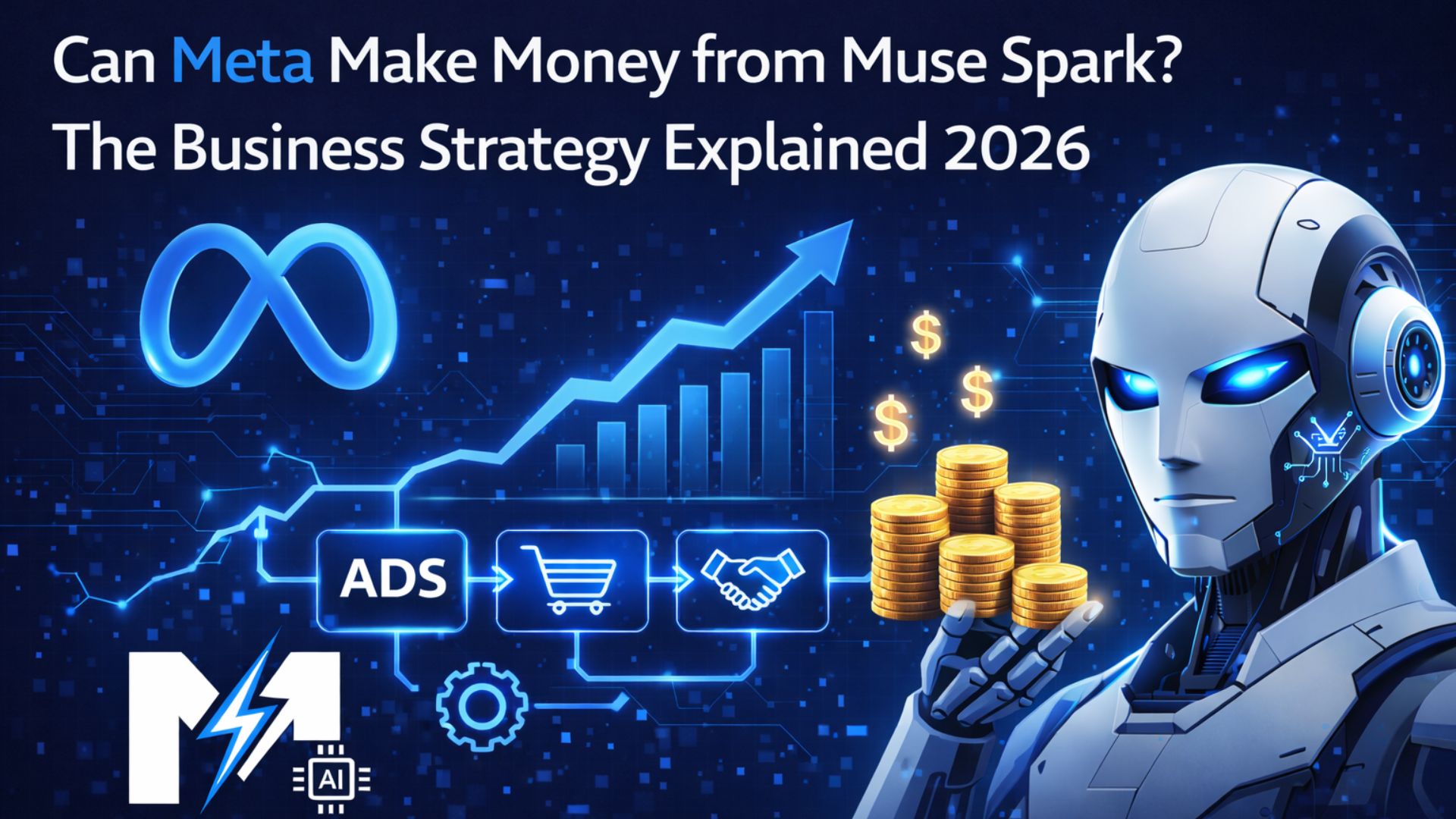
Can Meta Make Money from Muse Spark?
The Business Strategy Explained
Meta shifts from open-source Llama to proprietary Muse Spark — here is a full breakdown of Meta’s AI monetization strategy, what it means for developers, advertisers and investors, and whether the $14.3 billion bet on Alexandr Wang is paying off.
📋 Table of Contents
The Massive Strategic Shift: Open Source to Proprietary
For years, Meta’s AI strategy was built on open-source models. Its Llama family gave developers free access to powerful base models — a strategy designed to build an ecosystem and prevent OpenAI and Google from monopolising AI infrastructure.
With Muse Spark, Meta has made a dramatic reversal. The new model is proprietary — closed-source, not freely downloadable, and not available for developers to run on their own hardware. This is a fundamental change that has major implications for Meta’s business.
Why the change? Two words: monetization pressure. Meta’s stock surged 10% in the week following Muse Spark’s launch — but investors have been watching Meta spend hundreds of billions on AI infrastructure while generating essentially zero direct AI revenue. That had to change.
⚠️ Developer note: Unlike Llama models (which you could download and run freely), Muse Spark is currently only accessible via meta.ai and the Meta AI app. A paid API is coming — but free self-hosting is no longer part of Meta’s model strategy.
The $14.3 Billion Investment
In June 2025, Meta made one of the largest bets in tech history: spending $14.3 billion to acquire a 49% non-voting stake in Scale AI and bringing its CEO Alexandr Wang in-house as Meta’s first-ever Chief AI Officer. Wang then built Meta Superintelligence Labs from the ground up, recruiting researchers from OpenAI, Anthropic and Google.
On top of the Scale AI investment, Meta committed $115–135 billion in capital expenditure for 2026 — nearly double the prior year — including construction of the Hyperion data centre (one of the largest AI computing facilities ever built).
💡 To put the scale of Meta’s investment in perspective: $14.3 billion is more than the entire annual revenue of many Fortune 500 companies. This is not a bet — it’s an all-in commitment to AI dominance.
Muse Spark’s Revenue Streams
Paid API Access
Meta plans to charge developers and businesses for access to Muse Spark via API — following the OpenAI and Anthropic playbook. Currently in private preview.
⭐⭐⭐⭐⭐ Highest PotentialAI-Enhanced Advertising
Muse Spark’s multimodal vision capabilities can create smarter, more effective ads for Meta’s 3+ billion users on Facebook, Instagram and Reels.
⭐⭐⭐⭐⭐ Core RevenueAI Shopping Mode
A “shopping mode” that combines Muse Spark’s intelligence with Meta’s user interest and behaviour data to create personalised shopping experiences.
⭐⭐⭐⭐ High PotentialPremium Consumer Features
Potential for premium subscription tiers with higher API rate limits, Contemplating mode priority access, or advanced features not available in the free tier.
⭐⭐⭐ Medium PotentialPaid API Access — The Primary Bet
The clearest and most direct path to Muse Spark revenue is through a paid developer API. Meta is currently running a private API preview with select partners — and a public API is expected to launch soon.
For context, OpenAI generates billions of dollars annually from API access to GPT models. Anthropic generates significant revenue from Claude API access. If Muse Spark can attract even a fraction of the developer market, the revenue potential is enormous.
Meta’s competitive advantage for API: price and efficiency. Because Muse Spark achieves competitive performance with 10x less compute than Llama 4 Maverick, Meta can potentially undercut OpenAI and Anthropic on price while maintaining healthy margins.
| AI Provider | API Status | Approx. Price | Model |
|---|---|---|---|
| OpenAI | Public | ~$15/1M tokens | GPT-5.4 |
| Anthropic | Public | ~$15/1M tokens | Claude Opus 4.6 |
| Public | ~$3.5/1M tokens | Gemini 3.1 Pro | |
| Meta (Muse Spark) | Private preview | TBA | Muse Spark |
AI-Powered Advertising — The Hidden Goldmine
Meta’s primary business is advertising — generating $201 billion in revenue in 2025, almost entirely from ads on Facebook, Instagram, Threads and WhatsApp. Muse Spark has the potential to significantly enhance this core business.
Muse Spark’s world-class multimodal vision capabilities are particularly valuable for advertising:
- Creating smarter, more visually compelling ad creatives from product photos
- Analysing ad performance with deeper visual understanding
- Generating personalised ad content based on user interests and behaviour
- Powering a “shopping mode” that blends AI intelligence with Meta’s user data
- Enabling dynamic video ad creation through the Vibes AI feature
One analyst quoted by CNBC noted that Muse Spark’s visual strengths make it particularly well-suited for advertisers: “Compared to Claude and Gemini, it definitely feels like it has more of a consumer bent” — designed for the visual, short-form content world that Meta’s advertising dominates.
What This Means for Developers
The shift to proprietary AI is a significant change for the developer community that relied on free Llama models. Here’s the honest picture:
- No more free self-hosting of Meta’s frontier models — Muse Spark cannot be downloaded
- API dependency — developers will need to pay Meta for access, as they do with OpenAI/Anthropic
- Open-source future unclear — Meta says it “hopes to open-source future versions” but has made no commitment
- Potentially competitive pricing — Meta’s compute efficiency could translate to lower API costs
- Deep Meta ecosystem integration — building on Muse Spark means deep integration with Meta’s social platforms
⚠️ For developers: The AI landscape is shifting. Meta’s move to proprietary models means the era of free frontier AI is ending. Budget for API costs in any project using Muse Spark.
Investor Reaction
Wall Street responded enthusiastically to Muse Spark’s launch. Meta’s stock surged nearly 10% in the five trading days following the April 8, 2026 announcement, closing at $629.86 per share on Friday.
The single-day jump of 6.5% outpaced the S&P 500’s 2.5% gain and Nasdaq’s 2.8% rise on the same day. Analysts cited several reasons for the bullish reaction:
- Proof that Meta’s $14.3 billion Alexandr Wang bet was producing results
- A credible path to AI monetization through API access
- The proprietary model approach signals Meta is “in the game” as a serious AI competitor
- Muse Spark’s advertising potential enhancing Meta’s core revenue engine
Meta trades at an attractive 18x P/E multiple — below Alphabet (23x) and Microsoft (19.6x) — suggesting the market had not fully priced in Meta’s AI potential before this launch.
Can Meta Make Money: The $325 Billion AI Market Opportunity
The prize Meta is competing for is enormous. According to Grand View Research, the global generative AI market is projected to grow from $22 billion in 2025 to $325 billion by 2033 — a compound annual growth rate of over 40%.
To capture a meaningful share, Meta needs Muse Spark to succeed across three fronts:
- Consumer adoption — growing the Meta AI user base to rival ChatGPT (Meta AI app already climbed to #5 on US App Store within 24 hours of launch)
- Developer ecosystem — attracting developers to build on Muse Spark via API
- Advertising enhancement — using AI to grow Meta’s already dominant ad business
Key Challenges Ahead
- ⚠️ Developer trust: Switching from open-source champion to proprietary vendor is a reputational risk with the developer community
- ⚠️ Privacy concerns: Meta’s data practices are a well-known sensitivity — using Muse Spark requires a Meta account, raising data concerns
- ⚠️ Benchmark credibility: Meta was previously caught inflating Llama 4 benchmark scores — rebuilding trust with independent evaluators is essential
- ⚠️ Coding gap: Muse Spark trails on coding tasks — a significant limitation for developer adoption
- ⚠️ Competition: OpenAI, Anthropic and Google are not standing still — all are releasing increasingly capable models
- ⚠️ Monetization unproven: Muse Spark’s API pricing is not yet public — the revenue model is still theoretical
✅ Bottom line: Muse Spark is Meta’s most credible AI product ever. Whether it can translate technical capability into sustainable revenue is the defining question for Meta’s AI strategy over the next 12–24 months.