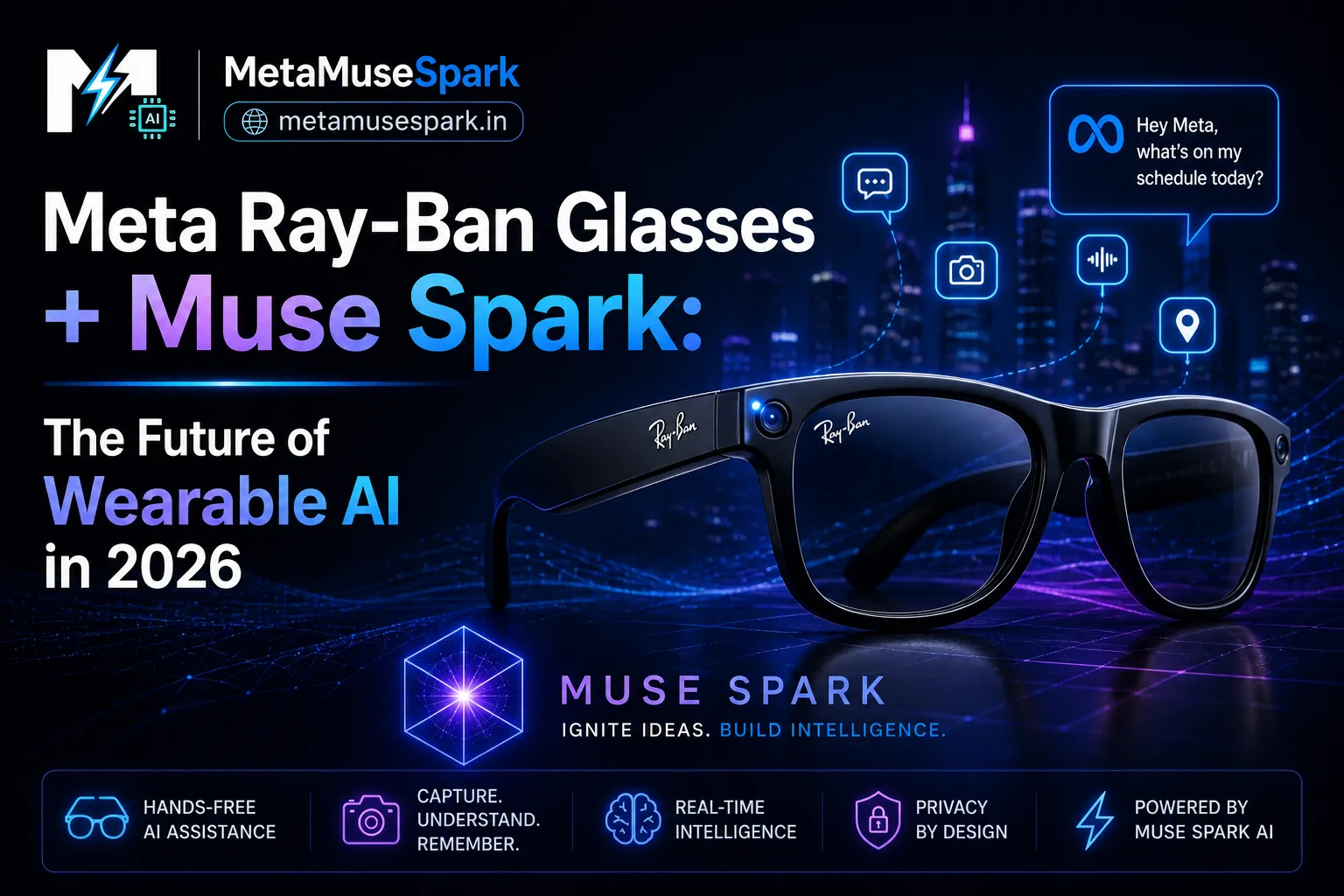
Meta Ray-Ban Glasses + Muse Spark:
The Future of Wearable AI in 2026
Meta Ray-Ban smart glasses are getting a massive upgrade in 2026 — Muse Spark, one of the world’s top five AI models, is now powering the on-glass AI experience. Here is what changes, what you can actually do, and whether the glasses are worth it.
When Meta first launched AI capabilities on Ray-Ban smart glasses, the experience was genuinely impressive for its time — but limited. The AI could answer basic questions, describe what the camera could see, and play music. It felt like a capable first step.
Muse Spark changes that equation fundamentally. With one of the world’s most capable frontier AI models now powering the on-glass experience, Meta Ray-Ban glasses in 2026 are positioned as something genuinely new: wearable frontier AI. The device you wear on your face can now access the same reasoning capabilities, vision intelligence, and health AI that powers the meta.ai web experience — but hands-free, in real time, in your everyday environment.
This article breaks down exactly what Muse Spark adds to the Ray-Ban experience, what the glasses can actually do, the privacy considerations, and whether this is a product worth considering.
💡 Key fact: Meta confirmed at the April 8, 2026 Muse Spark launch that the new model will power Meta AI on Ray-Ban smart glasses, rolling out alongside the broader Muse Spark deployment. The previous glasses AI was powered by an older Llama-based model.
What Are Meta Ray-Ban Smart Glasses?
Meta Ray-Ban smart glasses are a collaboration between Meta and the iconic eyewear brand Ray-Ban. They look like ordinary Ray-Ban sunglasses or clear-lens frames — but they include a camera, microphones, speakers, and a connection to the Meta AI assistant. You wear them like normal glasses and interact with the AI entirely by voice.
The glasses do not have a display or augmented reality overlay — they are audio-first. You ask a question, the glasses hear it, process it via Meta AI (running on Meta’s cloud servers), and speak the answer back to you through small built-in speakers. For the camera-based features, the glasses can see what you are looking at and describe, identify, or analyse it on request.
Before Muse Spark, the AI powering these glasses was capable but limited. With Muse Spark, the intelligence behind those same voice interactions is now dramatically more capable across reasoning, vision understanding, and health information.
What Muse Spark Adds to the Ray-Ban Experience
Smarter visual recognition
Muse Spark’s world-class vision AI (#2 globally) means the glasses can identify objects, read text, recognise landmarks, and describe scenes with significantly more accuracy and depth than before.
Real-time health info
Look at a food item and ask for nutrition information. Look at an exercise and ask which muscles it works. Muse Spark’s physician-trained health AI now works through the glasses camera in real time.
Genuine reasoning capability
The glasses can now handle complex multi-step questions — not just simple lookups. Thinking Mode reasoning is accessible hands-free, opening up more sophisticated use cases.
Real-time translation
Look at a sign, menu or document in another language and ask Muse Spark to translate and explain it — combining the glasses camera with Muse Spark’s language capabilities.
Shopping assistance
See a product in a shop and ask Muse Spark to find it online, compare prices, or suggest alternatives — the glasses camera feeds directly into Shopping Mode.
Extended conversation memory
Muse Spark supports longer conversation contexts, meaning the glasses can maintain the thread of an ongoing discussion more effectively across a walk or a commute.
Real-World Use Cases: What You Can Actually Do
The most compelling use cases for Meta Ray-Ban glasses with Muse Spark are those that benefit from hands-free, real-time AI assistance in the physical world. Here are the most practical scenarios.
Cooking: Keep your hands free while cooking. Ask Muse Spark what ingredients you are looking at, get step-by-step recipe guidance, ask for nutritional information about your ingredients, or request substitution suggestions if you are missing an ingredient — all without touching your phone.
Shopping: Look at a product on a shelf and ask Muse Spark to compare its price and specifications with online alternatives. Look at a food label and ask whether it is suitable for your dietary requirements. The visual shopping assistance that Shopping Mode offers becomes remarkably practical in a glasses form factor.
Learning and travel: Look at a historical building, a piece of artwork, or a natural landmark and ask Muse Spark what it is and why it matters. Read a sign in a foreign language and ask for a translation. These are use cases where hands-free AI assistance is significantly more natural than pulling out a phone.
Exercise: During a workout, look at gym equipment and ask Muse Spark how to use it correctly, which muscles it targets, and how to include it in your routine — without stopping to check your phone or tablet.
⚠️ Privacy consideration: Meta Ray-Ban glasses with an active camera raise significant privacy questions for the people around you. Always be transparent about wearing camera-enabled glasses in social situations. Some venues and jurisdictions restrict the use of recording devices in certain contexts. Use the glasses responsibly and respect others’ privacy.
Privacy: What Meta Sees When You Use the Glasses
When you use Meta Ray-Ban glasses with Muse Spark, the camera footage and audio are processed on Meta’s servers — not locally on the device. This means Meta has access to what your glasses camera captures when you invoke Meta AI, as well as your voice queries and the AI’s responses.
Meta’s privacy policy applies to all interactions with Meta AI through the glasses. The company uses data from AI interactions subject to the same policies that govern meta.ai and the Meta AI app. For users in India, the DPDP Act applies to data collected about Indian citizens, though AI-specific provisions remain limited in scope as of April 2026.
For full details on what data Muse Spark collects, read: Meta Muse Spark Privacy: What Data Does Meta Collect?
Are Meta Ray-Ban Glasses Worth Buying in 2026?
With Muse Spark powering the AI experience, the value proposition of Meta Ray-Ban glasses has meaningfully improved. The question is whether the hands-free wearable form factor justifies the cost for your specific use case.
The glasses are priced at approximately $299–$329 in the US (price in India, if and when available, has not been confirmed). For users who genuinely use AI throughout the day and want hands-free access — during exercise, cooking, travel, or commuting — the wearable form factor adds real convenience. For users who primarily use AI at a desk or for text-heavy tasks, the glasses add less incremental value over the phone app.
✅ Verdict: Meta Ray-Ban glasses with Muse Spark are the most capable wearable AI product available in 2026. If you want hands-free frontier AI and the use cases match your lifestyle, they are genuinely impressive. If you are primarily interested in Muse Spark’s text, reasoning, and health features, the meta.ai app or Meta AI mobile app gives you most of the same capability at zero cost.
Want to try Muse Spark without the glasses? Start with our guide: How to Use Meta AI Muse Spark for Free on Any Device.